
Archive for the 'Old Site' Category
Daily Bread
This bread has evolved over the last 6 months, ever since we realized that since every trip to the grocery store cost $40, buying bread every other day was pretty pricey. It started out as white bread following a Cooks Illustrated recipe for rustic Italian bread, then evolved to half whole wheat, then some of the whole wheat got replaced by wheat germ. This makes something like a reduced bran whole wheat bread, with more of the flavor and less of the bitter or grittiness of the bran. Less fiber too, oh well. Eat veggies or something too, you can’t live on bread alone.
This makes good toast or snacking bread, but hasn’t been making tall enough loaves to make a proper sandwich.
To Start:
- About 8-10 oz of whole wheat flour, and white flour to make up the rest to 22oz. (so that’s 12-14 oz. Depending).
- 1/2 teaspoon yeast
- 16 oz (2 cups) water.
Early in the morning, or the night before mix, cover, and let sit for 3 hours. Refrigerate or use immediately in the next stage. It will be a rough dough, and rise a little before adding to the next stage. If the flour is rather dry and doesn’t form into a dough from just the 2 cups, another 1/2 oz or so can help.
Later — Do this twice. I use a Kitchenaid mixer which can only hold 1/2 of the full batch at a time. Mix:
- 1 to 1 1/2 oz of wheat germ
- White flour to get up to 16.5 oz
- 2 teaspoons yeast
- 10.75 oz water
Mix till combined, then cover and set aside for 20 minutes. Next, combine this, 1/2 of the first stage dough and 2 teaspoons salt and knead in the mixer for 5 minutes or so until the dough is nicely elastic. Turn into a large greased bowl, cover with plastic wrap. Repeat for the other half of the first stage.
When the dough has risen some, fold over. It should take an hour or two per rise, but that really depends on the temperature. When it’s risen some more, split it into loaves. I use 4 9″x5″ loaves, but they aren’t terribly full. It would probably fill 8″ pans a bit better.
Preheat the oven to 450. I use a baking stone under the loaf pans, and it seems to bake nice and evenly. Let the bread rise in the loaf pans until there is a good shape to the loaves, then mist the tops with water, and put them in the oven.
After baking for 10 minutes, rotate the loaves and turn it down to 350. Bake for 25 more minutes or until the tops are nicely browned.
No commentsThings I want to Learn
- How to make the hand cut noodles at Snappy Dragon. Closely followed by how to make the veggie pot stickers. Even with all of the other good food there, plain noodles and pot stickers makes a meal good enough to travel for.
- How to make Essential Food’s Fremont Bread. It’s a moderately aggressive white sourdough, with a very open structure. Or Columbia — I have the recipe for that one. Just haven’t gotten all of the ingredients or the nerve lined up.
- How to make something like the Aloo Ghobi from India Bistro.
None of these are expensive, and none should be that hard to make. I don’t want to learn so that I don’t have to go to these local businesses, I just want to be able to do it.
No comments2 from a week
I’m trying to get both cats and the baby to all sleep in formation.

Last weekend, for the first time ever, I saw the fish ladder at the Ballard Locks. Took some pics here, of the dam, and of the railroad bridge, but no hassles. I guess parents with babies are supposed to be taking pictures.

Big old fish
heliocentric
Day one: Still exhausted from the delivery, still amazed at the little guy.
Day two: Slept most of the way through the nigh, figured that the sleep deprivation wouldn’t be too bad. Still no lost clothing to erps or accidents. Wonder what all the fuss about babies and laundry is.
Day three: Scratch one shirt when I didn’t have a spare along, and hmmmm, the little guy doesn’t want to sleep at night. Resolve to sleep when he sleeps if it’s dark out. He doesn’t really like the 95 degree heat wave sans air conditioning either.
Day four: Install air conditioner. He still doesn’t like sleeping between 11pm and 2am. But it’s getting easier to see some patterns.
Day five: Everything takes longer than I expect. 15 minutes to think about getting out the door, more if he gets hungry.
Day six: Huh. He actually slept in those early morning hours when he hasn’t slept before. Reiterate my desire to sleep when he sleeps.
It’s amazing how 9 pounds of baby can completely change the center of your life, influencing everything in it.


Avocado Curry, revisited
This is another shot at avocado curry, now that I’m beyond using curry powder and other methods of cheating.
Start with a yellow curry paste:
1 large onion
5-6 cloves garlic
10-12 quarter sized pieces of ginger
one serrano
1 tsp tumeric
1 tsp garam masala
a touch of lime juice
cayenne pepper to taste
Use a food processor to make a paste, then cook in peanut oil, in a nonstick pan, medium high for 3ish minutes, then medium for another 10 till it’s browned somewhat. A spatter screen really helps keep tumeric from coating your stove. Set aside to cool.
1 block tofu
2 large avocados
1 1/2 cups ground tomatoes
1 tbsp coriander, ground
1/2 tbsp cumin, ground
2-3 cups vegetable broth or water.
A couple of handfuls of cashews, lightly salted.
Cut a block of tofu into 1/2 ” pieces, remove the good stuff from the avocados. Fry the tofu in a little peanut oil (med-hi) till lightly browned, then add the spices, stir and let them cook for a minute or so. The spices should bubble and simmer in the oil, I cheated and added a little extra ghee. Add the tomatoes, stir while they lose their water, 3-4 minutes. Once again, a spatter screen keeps you from redecorating your kitchen with tomato spatter. Add the yellow curry paste, stir till it’s well incorporated. After a couple of minutes, start adding the vegetable broth, then add the avocados, and stir. Keep adding the vegetable broth for a few minutes, then turn the heat down to med-low, add the cashews and let cook for 10 minutes or so. Adjust salt and cayenne pepper after adding the cashews.
Right at the end, add 1/2 tsp garam masala, about a tablespoon of lime juice, and a tablespoon or two of fresh cilantro, chopped, and serve with rice and fresh pineapple on the side.
No comments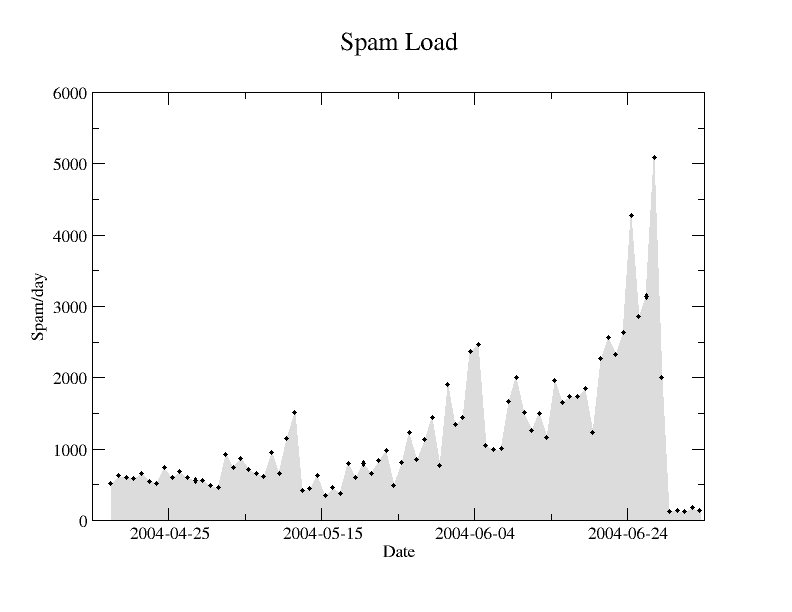
Spam Control
My mail system is now useless unless I’m on a broadband connection to the mailserver, and even then it’s pretty badly bogged down. And it’s all due to spam, roughly 50 thousand messages in the last month.
And that 50,000 messages is after spamcop’s realtime block list and spamassassin discarding anything over a 5 before it gets delivered to my mailbox in the first place.
I don’t think spamcop’s blacklist is actually making a difference — in the last 5 days of mail logs, I’m seeing 18000 rejected connections, while I’ve still seen 2000 spams a day getting to my account. I’m pretty sure that the spammers are using multiple trojaned proxy servers, and they just try untill they get through.
It’s not as bad as it could be, since I do have a reasonably good client side filter that keeps all but 10 or 20 of those a day out of my inbox, so I don’t have to individually delete them. But all of them have to be delivered and download, and that’s a real pain. And why it’s now useless to connecto to my mail on anything but a fast network. GPRS is right out.
To be honest, some of this is my fault, as I have a combination of issues that makes it a little more difficult than average to kill the spam. First, I’m running all my mail through a virus filter and spam assassin before address verification. That means postfix, the front end MTA, has the same problem that usually happens with backup mx machines: it has to accept the mail, process it, then deal with addressing. That’s not a problem with well addressed mail, but when there’s a dictionary attack on your domain, it’s not a pretty sight.
Second, I have a catchall email address, and I’ve been using it. So I don’t actually know which addresses are valid and which ones aren’t. I have a pretty good idea, but they’re not exactly all in code anywhere.
Third, this interacts really badly with spammers. I suspect that their adaptive proxy attack mechanisim records when an address has been accepted for delivery, so that they can refine their dictionary attacks for the next run. So the first attack probably added thousands of addresses in my domain to their lists, which they retry with annoying regularity.
However, there is a resolution. I have recently updated postfix to a version that allows delegation of address policy to permit greylisting. So I can delegate to a script to check for: known emails that I use from the wildcard domain, addresses from the backend mailserver, and most importantly, some spamtrap email addresses. If they’re good, I can accept them, if they’re bad, I can drop the whole connection. With Feeling.
No commentsAnother solstice picture
{picsPickerMacros.linkedImage(1802,1803)}
No comments